
________________________________________________________________________________________________________________
Overview
Corporate facility moves cost more than the visible expenses of movers, boxes, furniture, IT support, and construction. The hidden cost often comes from the repeated coordination, rework, and data cleanup required to manage workplace change across facilities, HR, IT, corporate real estate, and business teams.
This is especially true for everyday Move, Add, Change (MAC) activity, including box moves, seat changes, new hire placements, and small team shifts. This piece examines the cost side of MAC activity and how organizations can reduce move costs through defined business process, MAC workflows and integrations built with data and workplace system governance at core, leaving physical moves and digital records in alignment.
________________________________________________________________________________________________________________
The Operational Cost of Constant Workplace Change
With team reorganizations, hybrid work patterns, neighborhood planning, consolidation efforts, and shifting portfolio strategies, workplace change is no longer occasional. These items have made movement a recurring part of corporate facilities management in today’s workplace.
Some movement happens through large, planned projects like a large relocation, consolidation of floors, relocation of a department, redesign of a workplace neighborhood, or team shift as part of a broader portfolio strategy. These moves are important because they often involve formal budgets, executive visibility, vendor coordination, and clear timelines.
There are other moves happening more frequently though, that arguably affect the cost even more. This movement happens through smaller, one-off requests. This could be an employee changing seats, a team adding three new hires, a department shifting across the floor, or a workstation being reassigned after a role change. These everyday moves can be easier to overlook because they do not always feel strategic, yet they do represent a persistent operational cost.
Industry benchmarks reinforce the scale of these everyday moves activity. According to IFMA’s Space and Project Management Benchmarks, the average office churn rate is 32%, with move costs varying by type, including an average of $142 for box moves and $689 for furniture moves. Even when using a blended average of $300 per move, annual costs can become significant across a large portfolio.
The direct cost of moving someone from one seat to another, however, is only one part of the equation. For the real costs of move activity, organizations need to dig deeper and explore if their move processes are strengthening the accuracy of the workplace space management system or slowly eroding it.
The Hidden Drag Behind Workplace Movement
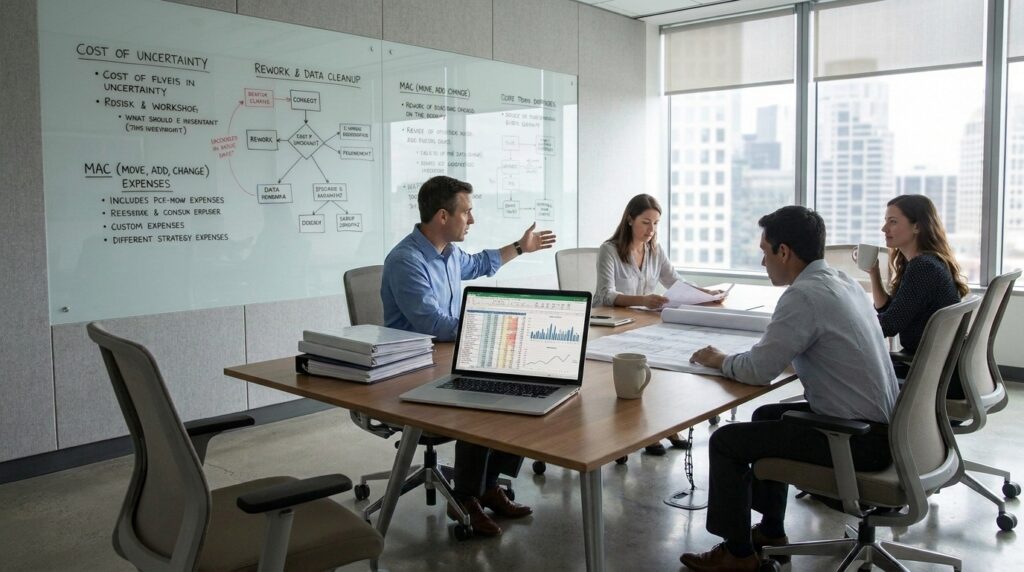
Most organizations can identify the cost of a major office move once vendors are involved. What’s harder to measure is the cost of uncertainty, rework, and data cleanup surrounding both large projects and everyday move activity.
When floor plans are outdated, seating data is incomplete, or space assignments are managed across disconnected tools, facilities teams spend time validating basic information before work can begin. They confirm who sits where, which spaces are available, which teams are affected, and whether the current plan reflects actual conditions.
This work is necessary when data can’t be trusted, but it’s also avoidable when you have a system that is truly acting as a single source of truth. A single inaccurate seat assignment may seem minor during a routine box move, however, in a larger restack, the same data issue that seemed minor at the time compounds and now affects multiple teams, timelines, and downstream decisions. Across hundreds or thousands of moves, those discrepancies become a recurring operational burden.
Poor data quality isn’t just frustrating for the facilities and corporate real estate teams; it has a measurable enterprise cost. Gartner reports poor data quality costs organizations at least $12.9 million per year on average. While this figure applies broadly across enterprise data, the same principle holds in workplace operations: when data is unreliable, teams spend more time correcting, validating, and defending decisions than acting on them.
The hidden cost of move activity often appears in five places:
- Manual coordination across facilities, HR, IT, security, business units, and corporate real estate.
- Rework caused by outdated floor plans, seating records, space types, or employee assignments.
- Productivity loss when employees arrive without clear direction on where to sit, which desk is assigned to them, or whether their equipment and access needs are ready.
- Delayed decisions when leaders do not trust the data behind capacity, vacancy, or utilization.
- Data drift when moves happen physically but are not reflected accurately in the workplace system.
These costs affect large relocations, consolidations, and restacks, but they are especially important in routine move, add, change activity because small errors repeat more often. Everyday movement either keeps the workplace system current or quietly pulls it away from reality and that’s why mitigating your hidden costs with these 5 steps can save your organizations, headaches, frustrations, and thousands:
1. Start With Reliable Space Data
The first way to reduce move costs is to reduce the amount of investigation required before any workplace change can happen.
For a large move, unreliable data can slow planning, complicate sequencing, and create uncertainty around capacity, adjacency, and timing. For an everyday box move, the same issue shows up in smaller but repeated ways. Facilities teams may need to confirm whether a seat exists, whether it is vacant, whether it belongs to another department, whether the workstation is usable, and whether another planned move already affects the same area.
This validation work rarely appears as a formal move cost. It shows up as time spent checking spreadsheets, walking the floor, sending emails, and reconciling competing records. The move itself may be large or small, but the effort required to confirm basic conditions can become disproportionately high when the underlying data is unreliable.
Accurate space data changes the starting point. When floor plans, seating assignments, space types, departments, and occupancy records are current, teams can evaluate move requests with more confidence and less manual reconciliation.
A reliable space management foundation should answer basic operational questions quickly:
- Where are people currently assigned?
- Which seats are available?
- What spaces are shared, dedicated, restricted, or specialized?
- Will necessary adjacencies be maintained with this move?
- What capacity exists within the current footprint?
- What changes are already planned?
Reducing move costs begins by making sure the organization does not have to rediscover its own workplace every time a move is requested.
2. Standardize Move, Add, Change Requests and Approvals
Move costs increase when every request enters the organization differently.
For large relocations and restacks, inconsistent intake can create confusion around scope, approvals, phasing, and communication. For everyday moves, the same inconsistency often appears through informal channels. One manager may send an email asking for a seat change, another may message a facilities team member directly, or new hire may be assigned to a seat before the system is updated.
These informal paths may feel frictionless in the moment, but they create downstream cost. They make it harder to understand move volume, prioritize requests, coordinate with IT, maintain accurate records, and identify recurring sources of churn. When the move process is unclear or too difficult to follow, employees may create their own workarounds, including “midnight moves” that happen outside the formal workflow. Over time, these off-process moves weaken the system of record, create gaps between planned and actual occupancy, and limit visibility for requestors trying to understand where they are in the queue, when their move is scheduled, or how the request is progressing.
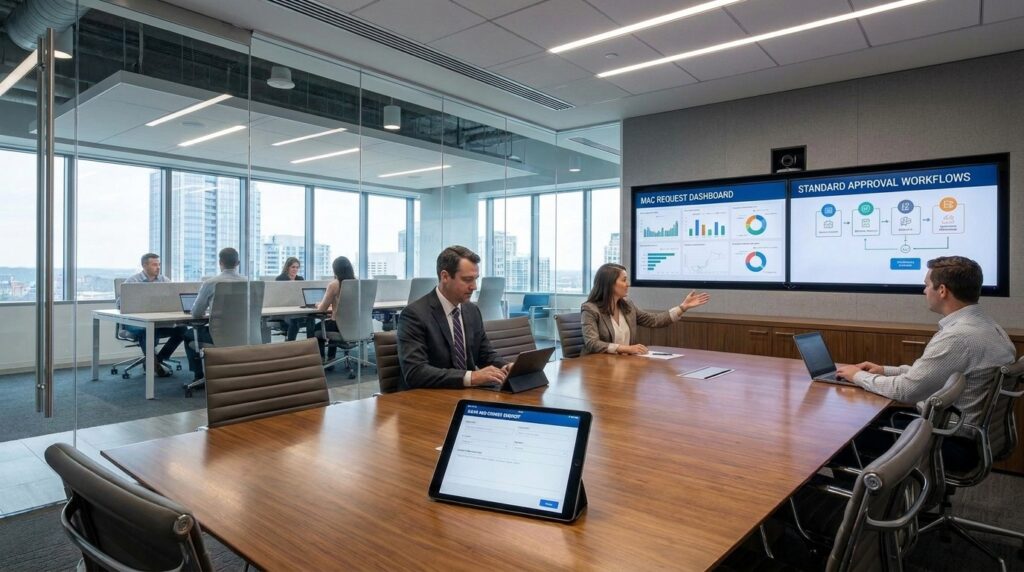
Standardized Move, Add, Change workflows reduce this variation. The process does not need to be heavy, but it does need to be consistent. Each request should capture who is moving, where they are moving from, where they are moving to, why the move is occurring, who approved it, and when the change should take effect.
This structure gives facilities teams the information they need without turning every box move into a major project. It also creates a record of movement, which helps the organization understand where routine churn is coming from and whether it can be reduced.
When move, add, change activity becomes standardized, it becomes measurable. Facilities leaders can begin to see move volume, cycle time, recurring issues, request patterns, and the operational friction contributing to unnecessary cost.
3. Use Occupancy and Utilization Data Before Approving Moves
One of the most effective ways to reduce move costs is to avoid moves that do not need to happen.
This applies to both major workplace changes and smaller day-to-day requests. A large restack may be proposed because a department appears to need more space or a routine seat change may be approved because a team feels full. In both cases, better occupancy and utilization data can help determine whether movement is actually necessary, whether another solution is available, or whether existing space can be used differently.
Occupancy data shows who is assigned to space. Utilization data shows whether space is being used and how frequently, which may be measured by space, person, or reservation pattern. Together, these data points help facilities and real estate teams distinguish between issues of capacity, assignment, adjacency, utilization, and employee experience.
This distinction is especially important in hybrid workplaces as teams may appear constrained on paper but use space inconsistently across the week. Another area may appear available but serve an important purpose because of adjacency, privacy, equipment, or workstyle needs.
IFMA’s FMJ reports 78% of organizations collect some form of occupancy data, but only 34% feel confident in their measurement capabilities. That gap matters because data collection alone does not reduce cost but the confidence in the data is what allows teams to act.
Move cost reduction depends on knowing not only where people can move, but whether they should move. The lowest-cost move is often the one an organization avoids because it has better visibility into current space conditions.

4. Coordinate Cross-Functional Dependencies Earlier
Move activity rarely belongs to one department.
Large relocations may involve project teams, vendors, communications, IT, HR, security, and business leaders. Smaller box moves may appear simpler, but they often rely on many of the same functions. Employees may need equipment moved, monitors reassigned, docking stations configured, network access confirmed, badges updated, or storage relocated.
When these dependencies are discovered late, the move slows down. Facilities may be ready, but IT is not, the seat may be available, but access is not updated or the employee may physically relocate, but the documentation is incomplete.
Connecting workplace data across functions helps reduce this friction and provides a clearer view across the organization. We see it many times where HR holds the employee and department information, IT manages assets and technology needs, facilities owns floor plans and seating assignments, corporate real estate tracks buildings, leases, and portfolio strategy and security manages access. That’s a lot of departments and a lot of opportunity for processes to fall apart and increase costs.
When these datasets are disconnected, move management becomes a manual reconciliation exercise. This is true during major projects, but it is also true when one employee changes seats and multiple systems need to reflect the same change.
Reducing move costs requires earlier coordination between the functions involved in workplace change. The workflow should make downstream needs visible at the time of request, not after people are already moving.
5. Close the Loop After Every Move
A move is not complete when people change seats. It is complete when the physical workplace and the workplace and/or space management system match.
This applies to a major relocation, a floor restack, a department shift, and a single box move. If employees move without the system being updated, the seating chart begins to drift from reality. In hybrid workplaces, that drift becomes even more visible when assigned seats, bookable desks, and reservable spaces no longer match what employees experience on-site. Over time, reports become less reliable, vacancy data becomes harder to trust, and future moves require more manual validation.
Every move should update the employee assignment, seat status, department information, floor plan record, and any relevant reporting fields. Without this discipline, the organization pays for the same move more than once: first to complete it, and later to correct the data it disrupted.
This is where routine movement becomes especially important. Large moves are usually documented because they have formal project structures but everyday box moves or midnight movers are more likely to be missed, which means they can quietly degrade the workplace system over time.
Data confidence is not only a reporting issue, it’s an operating condition. When the workplace space management system reflects reality, teams can make decisions with less friction and more confidence. Measurement is part of that closeout discipline. Tracking move volume, request patterns, completion times, rework, and missed updates helps facilities leaders understand where churn is coming from and where cost can be reduced.

From Move Execution to Cost Control
Reducing move costs in corporate facilities is not only about making moves cheaper. It’s about reducing the waste surrounding them.
The most effective organizations manage moves as part of a connected workplace and space management system. They understand movement as a recurring operational reality, not only a one-time project. They maintain accurate floor plans, define clear MAC processes, connect data across functions and systems, and use workplace insights to determine when change is necessary, where it should happen, and how it should be executed.
This discipline matters for large relocations, consolidations, and restacks. It also matters for the everyday box moves and seat changes that quietly shape the accuracy of the workplace over time.
The hidden cost of moves is not only the expense of relocation. It is the cost of making workplace change without confidence. When move management is supported by reliable space data and clear operational workflows, organizations can reduce unnecessary movement, minimize rework, improve coordination, and make better real estate decisions with less friction.
The organizations best positioned to control move costs are not simply moving people faster. They are managing workplace change as part of a larger space management system, where every move improves the accuracy of the data behind the next decision.
Reduce Your Hidden Cost of Moves, Add, and Changes (MAC)
For media inquiries, email info@apex42group.com.