
________________________________________________________________________________________________________________
Overview
The movement of people is a constant in every workplace but the process by which it’s managed is far too often an afterthought. Moves, Adds, and Changes (MAC) are a core function of modern workplace management software, helping organizations manage employee moves, workspace updates, and real-time workplace data accuracy.
As organizations have settled on hybrid work and more flexible space strategies, the pace of change has increased while processes often remain inconsistent, fragmented, or unclear. The result is not just operational friction, but data that no longer reflects reality.
This guide defines Moves, Adds, Changes (MAC) processes in the modern workplace, aligning people, systems, and workflows to keep workplace data accurate and decisions grounded in a reliable operational foundation.
________________________________________________________________________________________________________________
Workplace strategy is often discussed in terms of space optimization, hybrid policies, and portfolio decisions, but the foundation that determines whether any of those strategies actually succeed is far more operational. Move, add, change processes are the mechanism through which workplace strategy is continuously executed in real time. Every time an employee is relocated, a team is restructured, or a space is reallocated, MAC processes translate to strategic intent into physical and digital reality.
Because of this, move, add, change processes are not just administrative workflows, but rather they are the connective layer between workplace strategy and execution. When they are clear, consistent, and well-aligned, organizations are able to trust their data, respond quickly to change, and ensure that space decisions reflect how the business actually operates. When they are fragmented or poorly defined, even the most sophisticated workplace strategy begins to drift from reality, creating gaps between planning and execution.
In many ways, Move, Add Change (MAC) processes reveal whether a workplace strategy is truly operationalized or simply documented. They determine how quickly organizations can adapt, how accurately they understand their environment, and how confidently they can make decisions about space, cost, and experience. This is why MAC is not a back-office concern, but a strategic enabler that sits at the core of every major workplace decision.
What is a Move, Add, Change (MAC) Process?
Move, Add, and Change (MAC) processes are the structured workflows organizations use to manage changes in the workplace. This includes relocating employees, assigning workspaces to new hires, vacating workspaces for departing employees, updating existing workspaces, and modifying team configurations. At their core, MAC processes ensure that workplace data remains accurate, employees have the spaces and tools they need, and operational changes are executed efficiently.
While these activities are routine, the impact of poorly defined MAC processes is significant: inconsistent data, misaligned systems, lost time and productivity and decreased confidence in decision-making. In today’s dynamic, hybrid workplace, MAC processes have evolved from operational tasks into an essential workflow that enables occupancy planning readiness and reduces friction in the employee experience.
Move, Add, Change (MAC) Processes in a Changing Workplace
Moves, Adds, and Changes (MAC) have long been central to workplace management, happening every day as employees move, new hires take their places, and teams reorganize.
Historically, defining MAC processes was relatively straightforward, with most employees having assigned seating, moves being planned in advance, and changes occurring at a manageable pace. The process wasn’t perfect, but it was predictable. And predictability makes things easier.
That predictability began to erode as workplaces started to evolve. Some organizations transitioned to neighborhood-based seating, while others maintained assigned desks with increased flexibility. Although these shifts introduced new considerations, MAC processes remained manageable.
Hybrid work has introduced a new layer of complexity, accelerating the pace of change across the workplace as employees split their time between home and the office, teams operate on rotating schedules, and moves increasingly occur without individuals physically present. At the same time, space utilization shifts from week to week while workplace strategies continue to evolve in real time. As both the speed and variability of change increase, the need for clear, well-defined MAC processes becomes even more critical.
As the workplace evolves, Move, Add Change (MAC) processes must evolve with it, making clear, consistent definition not just beneficial but essential to managing increasing complexity. Many organizations are still working toward that level of clarity, highlighting the role of experienced advisors in defining processes, aligning stakeholders, and establishing the systems and workflows needed to support effective MAC management.

The Role of Definition in Move, Add, Change (MAC) Processes
As workplace complexity has increased, MAC processes have started to feel more complicated than they need to be, and because of this, additional tools, systems, stakeholders, and workflows have been introduced, furthering the complication. Each new layer adds operational overhead and increases the likelihood of inconsistencies which creates disconnected updates, duplicate data entry, and unclear ownership – ultimately contributing to gradual data degradation.
Transforming the workplace means engaging a complex network of stakeholders and systems, but complexity itself is not the answer to fragmentation. Clarity is. Simplicity isn’t about doing less or “easy”. It’s about creating alignment by designing processes that are intuitive, consistent, and transparent. When processes are clear, they work as intended. They scale with the organization, reinforce consistency, and sustain the data integrity needed for confident decision-making.
From Change Activity to Data Reliability
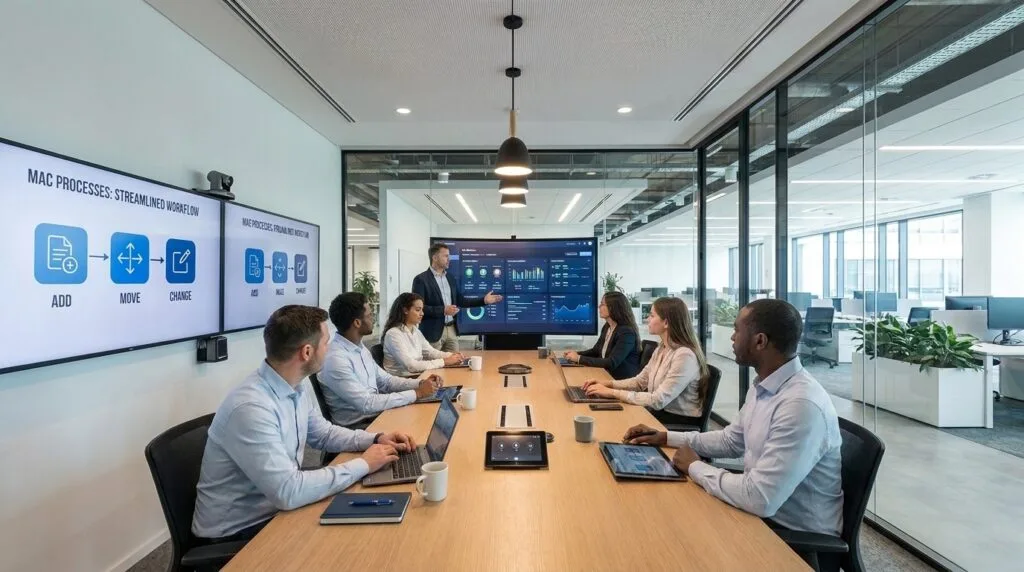
Defining Move, Add, Change (MAC) processes in the modern workplace is ultimately about maintaining reliable workplace data. When the move process is strong, the data starts clean and stays reliable, but that takes more than just software. It takes people working together, clear processes, and tools that support how teams operate day-to-day.
A single move can involve multiple teams and systems, from Facilities and IT to Human Resources, business unit leaders, and even employees themselves. The challenge is not the number of moving parts, but how those parts are coordinated. Breakdowns occur when teams operate differently, updates exist across disconnected systems, the purpose of the process is unclear, or manual steps persist where automation could support consistency. Over time, this lack of alignment introduces friction and increases the likelihood of missed or inconsistent updates.
These breakdowns often begin with seemingly minor changes, such as an employee self-moving to a newly vacant desk, or a remote employee transitioning to hybrid work without updates to space assignments or the HR system, or even a hoteling space becoming a permanent seat. Individually, these events appear insignificant. Collectively, they erode data reliability and confidence which erodes the speed at which the Real Estate and Facilities teams can plan and manage the next project. This is how operational inconsistency becomes a strategic limitation.
The Operational Structure of Move, Add, Change Processes
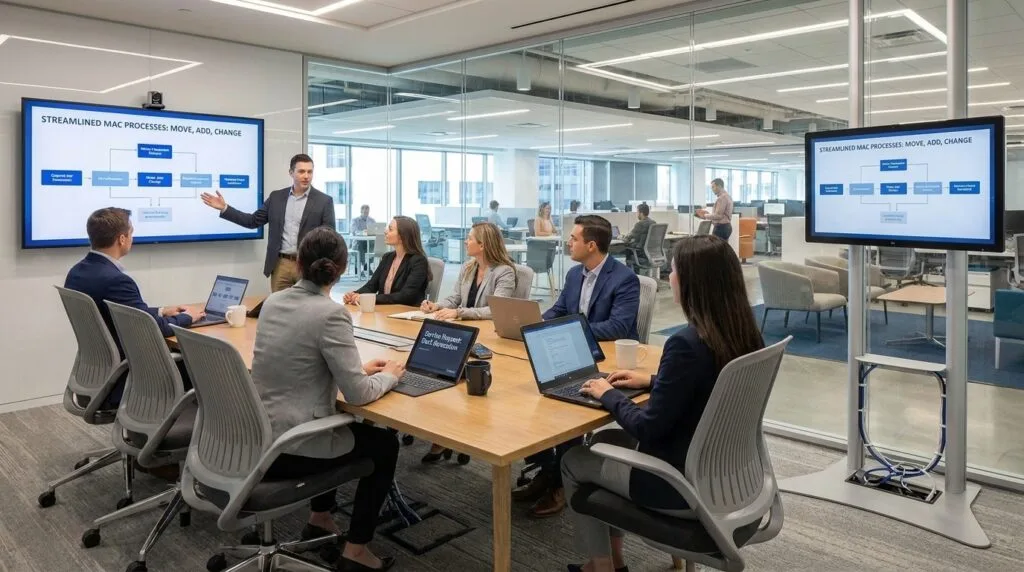
Hybrid work has accelerated the rate of workplace change. Employees move more frequently, teams reorganize more often, and space usage continues to evolve. At the same time, not all changes follow formal processes, often because those processes are unclear or overly complex.
Process adoption depends on usability, and when workflows become overly complicated or fragmented across multiple systems, compliance declines. The goal isn’t to create a perfect system. The goal is to create one that people will actually use.
That means:
- Clear process steps
- Defined ownership
- Consistent workflows
- Connected systems
Simplicity in structure reduces operational friction. Reduced friction increases adoption. Increased adoption improves data accuracy. Modern MAC processes may still involve multiple stakeholders, systems, and approvals. However, when structured effectively, complexity can be present without compromising clarity.
An Enabling Capability for Decision-Making
In the modern workplace, Move, Add Change (MAC) processes extend beyond operational coordination. They serve as a foundational capability for data-driven decision-making.
Organizations increasingly rely on workplace data to support:
- Hybrid workplace strategies
- Space optimization initiatives
- Real estate cost management
- Organizational planning
However, these initiatives depend on accurate, up-to-date workplace data. MAC processes are a primary mechanism through which this data is maintained.
In many organizations, MAC processes evolve organically over time. Different teams establish independent workflows. New tools are introduced without alignment. Data ownership becomes unclear. Over time, visibility across the full process diminishes.
Defining MAC processes often begins with foundational questions:
- Where should change requests originate?
- Which system serves as the source of truth?
- How are updates propagated across systems?
- Where can automation improve consistency?
Automation plays an important role in modern MAC processes, particularly when used to reduce manual effort and improve alignment. Examples include:
- Automatically updating multiple systems from a single change
- Triggering notifications when moves are approved or completed
- Synchronizing space data across platforms
- Reducting duplicate data entry
These incremental improvements strengthen data integrity and reduce operational risk. Over time, they create a more resilient workplace management framework.
When MAC processes are clearly defined:
- Operational consistency improves
- Data accuracy is maintained
- Systems remain aligned
- Decision-making confidence increases
MAC processes are no longer limited to operational execution. They represent a repeatable framework for keeping workplace data aligned with organizational real. In a workplace defined by constant change, clarity and simplicity in MAC processes become foundational capabilities. Technology by itself can’t serve as a bandage for fragmented processes, unclear ownership, or inconsistent data. Without the right structure and expertise behind it, even the best platform can end up reinforcing the very challenges it was meant to solve.
Start Building Smarter Move, Add, Change (MAC) Processes
For media inquiries, email info@apex42group.com.