
Editor’s Note: All em-dashes were intentionally place by a human.
The planning process was recently described by a Corporate Real Estate leader as, “Space planning always involves some degree of a leap of faith.” A business need arises; you gather forecasts and benchmarks and then develop scenarios. Ultimately, you take the leap—pick a path, sign off, and execute, and afterwards it gets handed over to facilities.
That’s the typical workflow. Strategy sets intent and assumptions; space planning (often referred to as programming at this stage) translates that into decisions about physical space. Design and construction bring decisions to life, while workplace and facility operations manage it moving forward.
The challenge with this workflow isn’t the handoff. It’s that each phase is treated as a distinct discipline—or a project that begins and ends—rather than part of a lifecycle that learns.
This idea of a learning loop extends beyond space planning. PropTech strategist Antony Slumbers describes the opportunity as creating a closed loop between decisions and outcomes—capturing the assumptions behind a decision, comparing them with what happens, and feeding that evidence into the next decision.
Applied to the workplace lifecycle, operations provides the evidence that closes the loop—testing the assumptions made during strategy and planning and informing what comes next.

How Workplace Strategy Informs Space Planning
Before we decide how much space is needed or how it should be organized, there are bigger questions to answer. How does the organization expect people to work? How often will they be in the office? What kinds of work should the workplace support? Are seats assigned or shared? Which teams need to be together? How much flexibility should be preserved?
Every scenario is based on a future we can’t completely predict—business needs will change and teams and attendance will evolve. Not to mention, AI is now restructuring roles, workflows, and the workforce in ways we don’t yet fully understand. So, while the physical workplace is relatively fixed, the demand placed upon it is not. This is why the “leap of faith” exists. CRE eventually must choose a direction based on the best information available at the time.
But what if you could make the next leap more informed than the last?
What Happens After a Space Plan is Implemented?
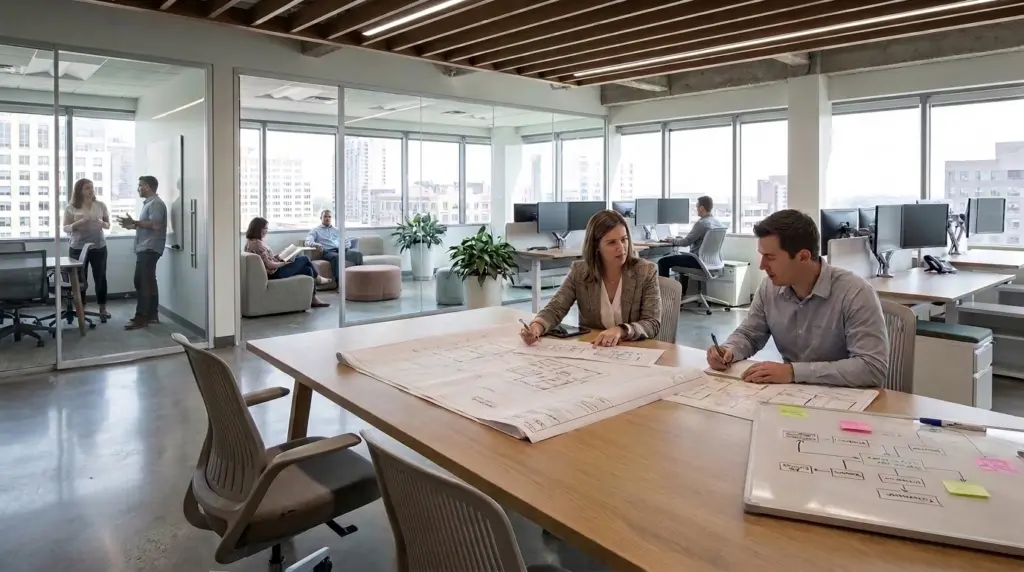
Once the workplace opens, the assumptions behind the selected strategy and space plan meet reality. Departments may have reorganized; changed size, and attendance may vary from the forecast. These changes provide evidence about how the organization has evolved snice the initial space plan was developed—and whether the assumptions behind the plan still hold. As time moves on, people will continue to come and go, change work modes and space assignments, space usage will change renovations will occur, and floor plans will be updated to reflect current state. Much of this activity is managed on the operations side of CRE and Facilities and while often viewed as administrative—together they maintain something much more valuable: a record of the workplace as it changes over time.
How Space Management Creates Better Workplace Benchmarks
External benchmarks provide a useful perspective and a way to challenge assumptions, but every organization is different. An organization’s own portfolio can be one of its most relevant sources of benchmarking—revealing what happened across different locations, strategies, and conditions over time.
This record is an important source of learning if the information is trustworthy.
If one location defines a seat differently from another, or measures capacity, utilization, or square footage differently, the comparison becomes questionable. The same is true if the Strategy or Space Planning team can’t easily access the information or understand how a number was calculated.
To create trustworthy internal benchmarks that can be used for planning and defending high-dollar real estate decisions, workplace records need to be consistent, transparent, and accessible.
Operational Data Informs Future Space Planning
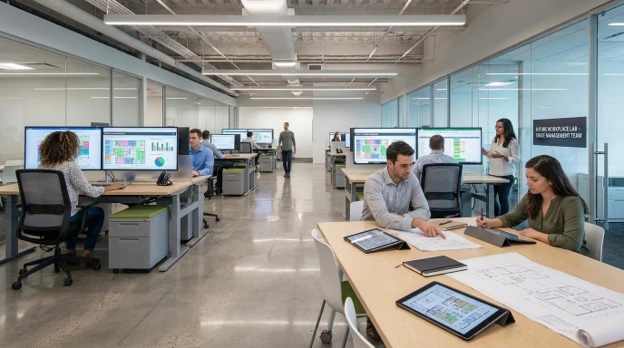
The value of that operational history isn’t simply knowing what happened. It’s being able to carry that evidence forward when it’s time to plan again.
Too often, that connection is lost. When another planning exercise begins, strategists and planners start pulling data and benchmarks from multiple sources and recreating the current state—rather than starting with what the organization has already learned.
The problem isn’t the handoff. It’s that the feedback loop doesn’t exist.
Space planning will always require assumptions—but better space planning carries operational evidence forward to make the next leap more informed. Once we start thinking about the workplace as an environment that produces evidence over time, the traditional linear space planning process looks incomplete. A modern framework carries the learning forward as a feedback loop, creating a cyclical nature for the real estate portfolio which is outlined as:
STRATEGY → SPACE PLANNING → EXECUTE → OPERATE.
A modern space planning framework carries that learning forward into a cyclical pattern:
STRATEGY → SPACE PLANNING → EXECUTE → OPERATE → LEARN → PLAN AGAIN.
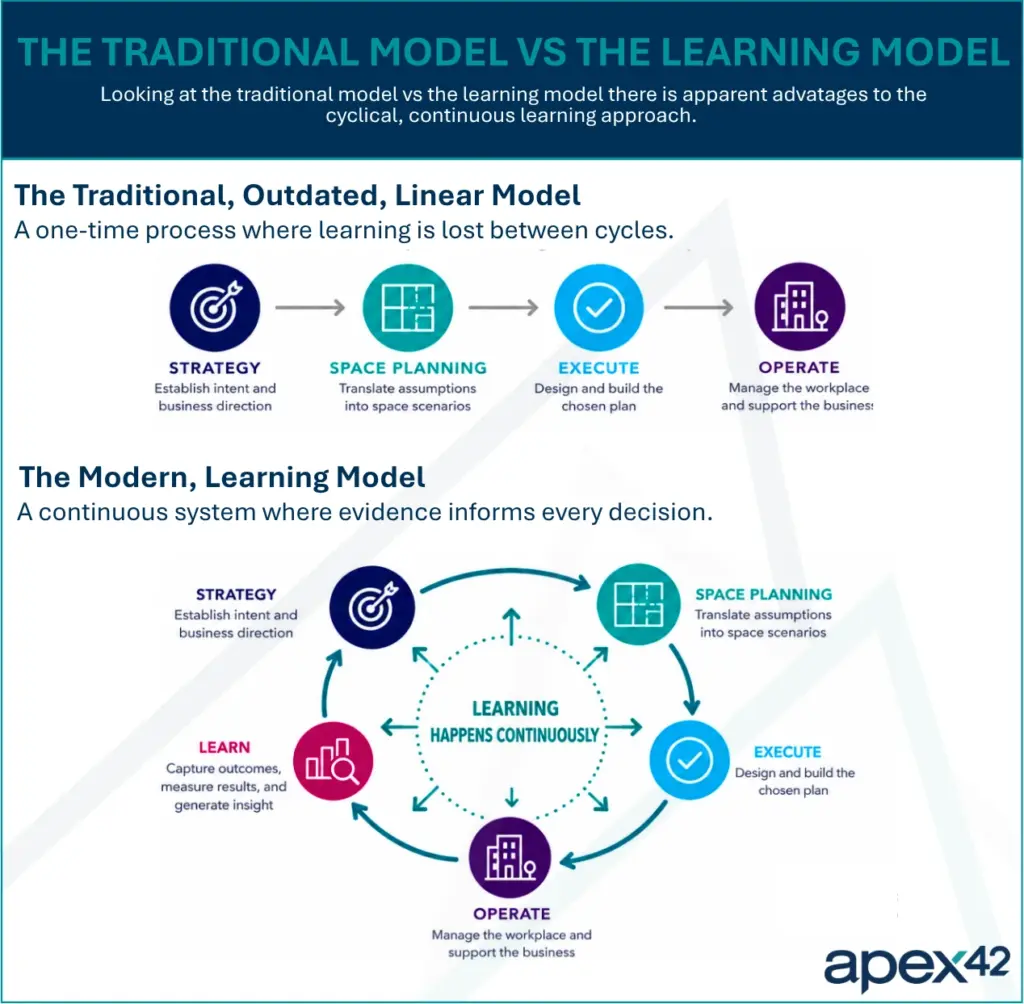
Strategy. Establish the intent, assumptions, and future direction of the workplace based upon the needs of the organization.
Space Planning. Translate strategic assumptions into physical space requirements. Explore how people, teams, capacity, adjacencies, and space could be organized and compare possible future states.
Execute. Put the chosen direction in place through design, construction, moves, assignments, and the other work required to realize the future state.
Operate. Maintain an accurate picture as people, teams, assignments, spaces, and business needs change.
Learn. Turn operational history into evidence for future decisions. Compare what was intended with what actually happened. Which assumptions held? What changed? What patterns are emerging? How are internal benchmarks evolving over time? What should that evidence tell us when the next planning decision arises?
Making current-state metrics and operational history readily accessible gives strategists and planners an internal benchmark to hold up against external ones.
Carrying those insights forward means the next planning cycle doesn’t have to start over. It can start with what the organization has already learned.
How AI Increases the Value of Workplace Data
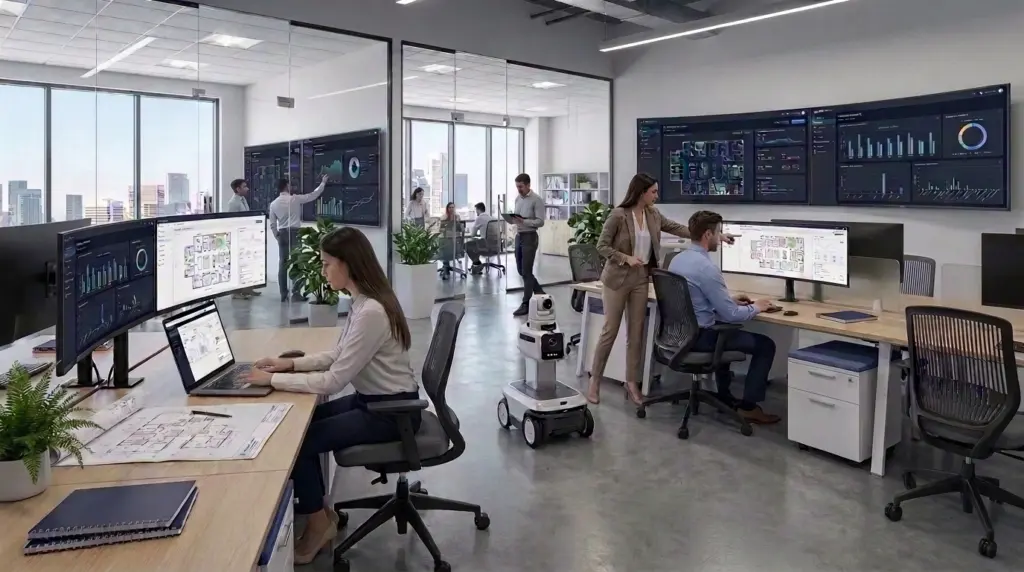
There is another reason why the learning model matters now. AI creates the potential to find patterns across years of workplace information, connect changes that might otherwise be difficult to see, and help CRE recognize where assumptions may deserve another look.
But AI can’t reliably learn from organizational evidence that wasn’t captured or preserved. And it can’t create confidence from measurements that have changed meaning from one location or year to the next.
The opportunity is giving AI context and history worth learning from: what we intended, what we planned, what happened, what changed, and what came next.
That context makes the operational record far more valuable to the strategists and planners who will be asking the next set of questions.
Making the Next Space Planning Decision More Informed
None of these steps in the cyclical learning model eliminates uncertainty from space planning—nor should we expect it to. There will always be a leap of faith, but it’s time to make the next leap more informed than the last one.
CRE leaders will continue to make decisions without knowing exactly what their organizations will look like three, five, or ten years from now. They will gather information, evaluate alternatives, exercise judgment, and eventually choose a direction.
Every space planning effort should begin with more knowledge than the effort before it. And every future workplace should benefit from the evidence created by the workplace in use today.
The organizations that create the best workplaces over the next decade may not be the ones that make the smartest first decision. They may be the ones that are best at learning from the decisions they’ve already made.
Make Your Next Space Plan Informed
For media inquiries, email info@apex42group.com.
Frequently Asked Questions About Modern Space Planning
How does operational data improve future space planning?
It shows how the workplace changed after a plan was implemented. Strategists and planners can compare what they expected with what happened, then use those findings to inform the next decision.
What information should organizations preserve after implementing a space plan?
Keep the assumptions behind the plan alongside consistent records of floor plans, capacity, assignments, occupancy, and subsequent changes. Together, they provide context for evaluating outcomes over time.
Why does AI need consistent workplace data?
AI can help identify patterns across workplace information, but its findings depend on the quality and meaning of that information. If measurements change between locations or over time without clear definitions, the patterns become harder to interpret reliably.